Table of contents
- What the AWS Certified Security - Specialty Exam Validates
- AWS Certified Security - Specialty Content Domains
- Exam Format, Question Types, and Scoring
- Candidate Background and Recommended AWS Knowledge
- Official Preparation Resources and Study Sequence
- A Source-Bounded Preparation Framework
The AWS Certified Security - Specialty (AWS SCS-C03 Dumps) exam is intended for individuals who have responsibility for securing cloud solutions. It validates a candidate’s knowledge of securing AWS products and services. For candidates researching AWS security certs, the supplied AWS materials describe the exam through its validated tasks, six content domains, response formats, scoring model, candidate background, and listed preparation resources.
This article stays within those supplied materials.

What the AWS Certified Security - Specialty Exam Validates
AWS describes the exam as validating knowledge about securing AWS products and services. The documented task scope is practical rather than limited to definitions: candidates are expected to demonstrate knowledge that applies data classifications, data protection mechanisms, encryption methods, secure internet protocols, security services, and security features in AWS contexts.
The exam documentation also includes decisions that account for tradeoffs between cost, security, and deployment complexity when meeting a set of application requirements. It includes understanding security operations and risks. These points provide a useful boundary for preparation: organize study around the documented security tasks and the domain outline rather than adding unrelated technical subjects merely because they may be associated with cloud computing.
Validated Security Tasks
The supplied exam guide states that the exam validates the ability to apply specialized data classifications and AWS data protection mechanisms. It also states that the exam validates the ability to implement data-encryption methods and AWS encryption mechanisms. Those two tasks place data handling and encryption directly inside the stated scope.
The guide further states that the exam validates the ability to implement AWS mechanisms that follow secure internet protocols. It states that the exam validates the ability to use AWS security services and features to ensure secure production environments. A preparation plan can therefore connect each practice activity to one of these stated tasks instead of treating practice as a general review exercise.
Another documented task is making decisions that account for cost, security, and deployment-complexity tradeoffs for application requirements. The guide also names security operations and risks as part of the knowledge the exam validates. Together, these statements describe the supplied exam scope without extending it into broader claims about all cloud-security work.
Topics Outside the Target Scope
The exam guide says that its out-of-scope job-task list is non-exhaustive. It identifies designing cryptographic algorithms as out of scope for the target candidate. It also identifies packet-level traffic analysis as out of scope.
The same guide identifies architecting overall cloud deployments as out of scope. Managing end-user compute resources is also listed as out of scope. Training machine-learning models is another task the guide says is outside the target candidate scope.
These exclusions do not describe every possible subject that could appear in a broader technical learning plan. They do show that the supplied guide distinguishes the stated security-specialty task scope from several other job tasks.
AWS Certified Security - Specialty Content Domains
The exam guide says that it provides weightings, content domains, and task statements, while also stating that it does not provide a comprehensive list of exam content. Its content outline divides scored content into six domains.
Detection accounts for 16% of scored content. Incident Response accounts for 14% of scored content. Infrastructure Security accounts for 18% of scored content.
Identity and Access Management accounts for 20% of scored content.
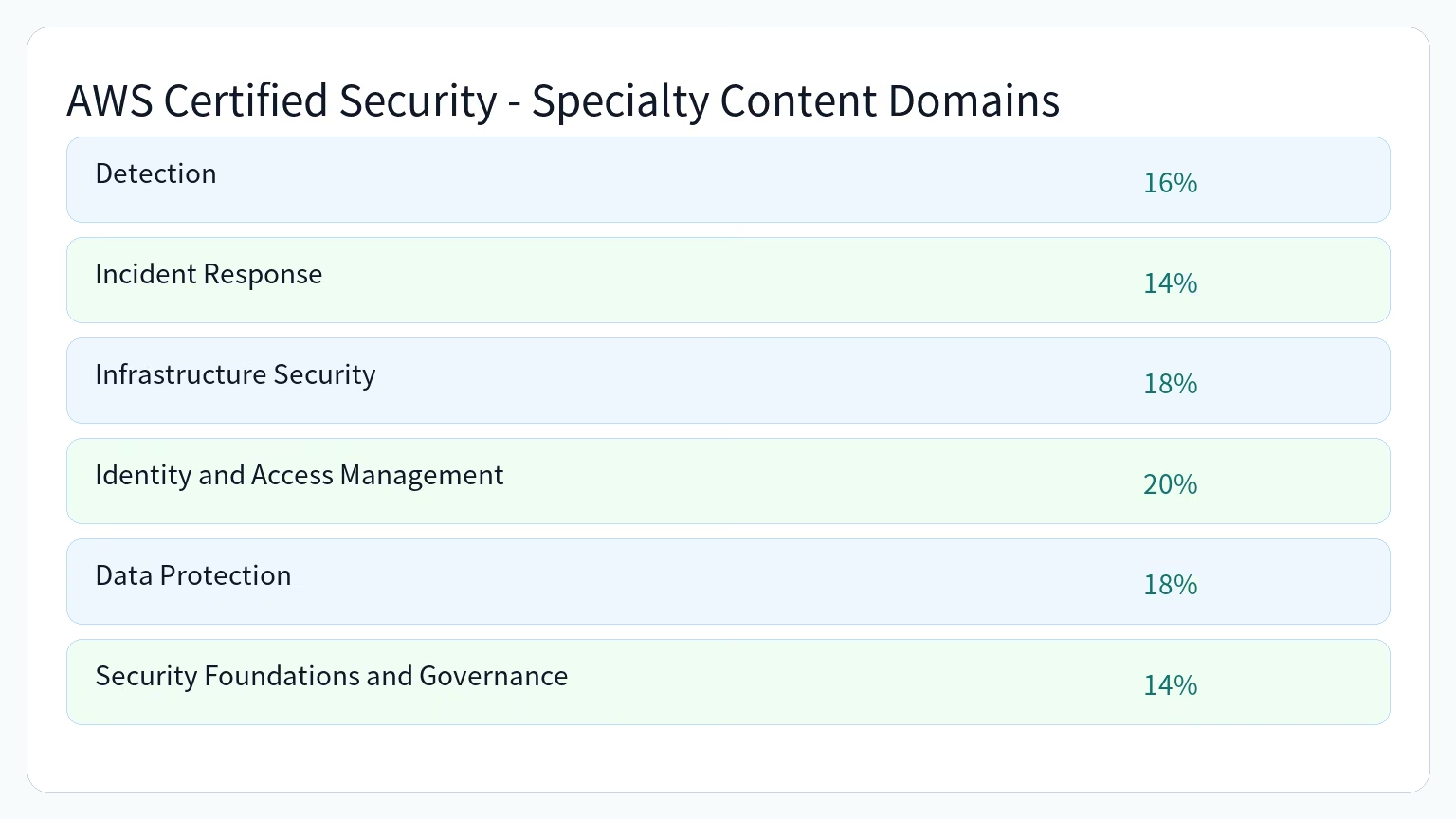
The domain percentages add structure to review planning, but the guide’s stated limitation still applies: the outline is not a comprehensive list of all exam content. Candidates can use the domains to organize review and then examine the documented topic alignment and AWS-service references described in the preparation materials.
Exam Format, Question Types, and Scoring
The AWS certification page lists an exam duration of 170 minutes. It lists the exam format as 65 questions that are either multiple choice or multiple response. The detailed exam guide additionally says that the exam includes one or more of four response types: multiple choice, multiple response, ordering, and matching.
The distinction between the certification-page overview and the detailed guide is worth preserving. The overview gives the stated duration and 65-question format, while the guide describes the response types that may appear. The supplied materials should be read together without inferring additional format requirements not stated in them.
The exam guide says that unanswered questions are scored as incorrect. It also says that there is no penalty for guessing. It states that 50 questions affect the score and that 15 questions are unscored. The guide further states that unscored questions are not identified on the exam.
AWS reports results as a scaled score from 100 to 1,000. The minimum passing score is 750. The guide describes the exam as having a pass-or-fail designation and says that the exam uses a compensatory scoring model, meaning a candidate needs to pass the overall exam rather than achieve a passing score in every section.
Response Types in the Exam Guide
A multiple-choice question has one correct response and three incorrect responses, which the guide calls distractors. A multiple-response question has two or more correct responses from five or more response options.
For ordering questions, the guide describes a list of three to five responses used to complete a specified task. It states that the candidate must select the correct responses and place them in the correct order to receive credit. For matching questions, the guide describes matching a list of responses with a list of three to seven prompts and states that all pairs must be matched correctly to receive credit.
When using exam-style questions, candidates can account for these stated response mechanics. The supplied AWS preparation sequence specifically includes exam-style questions, a practice-question set, flashcards, instructor-led guidance through exam-style questions, and an official pretest.
Scored and Unscored Questions
The guide states that 50 questions affect the score. It separately states that 15 questions are unscored and do not affect the score. AWS says it collects performance information on the unscored questions to evaluate them for possible future use as scored questions.
The guide says that unscored questions are not identified during the exam. Because the supplied documentation does not identify them in advance, the article cannot provide a method for distinguishing scored questions from unscored questions while taking the exam.
Candidate Background and Recommended AWS Knowledge
The exam guide describes a target candidate with the equivalent of three to five years of experience securing cloud solutions. A separate AWS certification page describes the exam as intended for experienced individuals with five years of IT-security experience designing and implementing security solutions and two or more years of hands-on experience securing AWS workloads.
These are descriptions from separate supplied AWS pages. They should not be combined into a newly derived eligibility requirement. The materials provide background context for candidates comparing their experience with the documented target profile.
The exam guide lists the AWS shared responsibility model and its application as recommended AWS knowledge. It also lists managing identity at scale, multi-account governance, and managing software supply-chain risks. Security incident-prevention and response strategies, cloud vulnerability management, and developing firewall rules at scale for layers 3–7 are included in the same recommended-knowledge list.
The guide additionally lists incident root-cause analysis, experience responding to an audit, and logging and monitoring strategies. It includes data-encryption methodologies for data at rest and in transit. Disaster-recovery controls, including backup strategies, are also listed.
Experience Descriptions in the Supplied AWS Sources
The exam guide’s three-to-five-year description concerns experience securing cloud solutions. The certification page’s description specifies five years of IT-security experience in designing and implementing security solutions and two or more years of hands-on experience securing AWS workloads.
Neither statement is rewritten here as a universal rule that combines both descriptions. The supplied sources instead present two distinct AWS descriptions that candidates can review alongside the documented exam scope and recommended knowledge.
Official Preparation Resources and Study Sequence
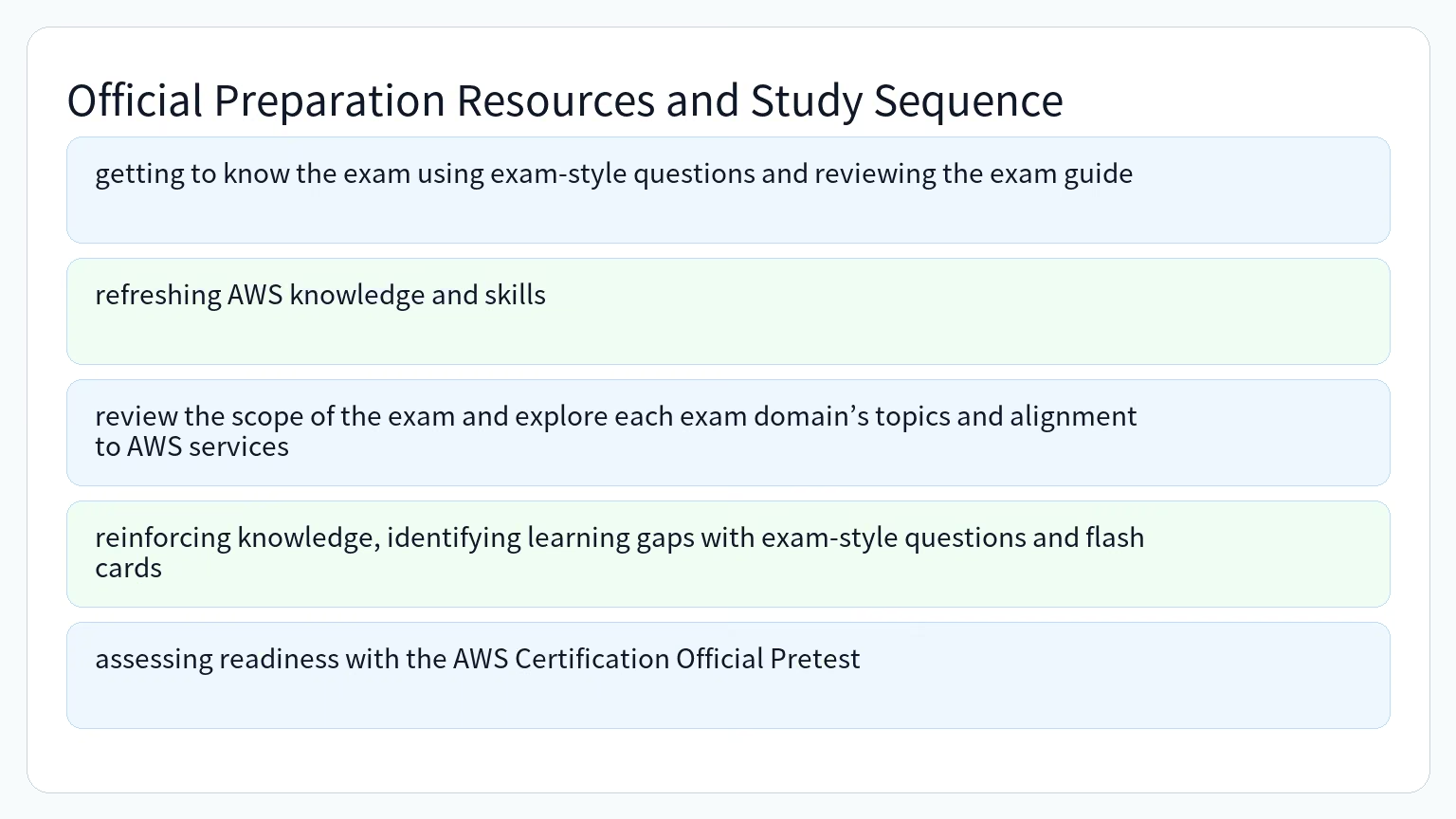
AWS directs candidates to its Exam Prep Plan on AWS Skill Builder. The stated sequence begins with getting to know the exam using exam-style questions and reviewing the exam guide. AWS also says that candidates can take the AWS Certification Official Practice Question Set to understand exam-style questions.
The next stated step is refreshing AWS knowledge and skills. AWS lists digital courses for knowledge and skill gaps, along with AWS Builder Labs, AWS Cloud Quest, and AWS Jam as practice resources.
AWS then instructs candidates to review the scope of the exam and explore each exam domain’s topics and alignment to AWS services. The same preparation step includes reinforcing knowledge, identifying learning gaps with exam-style questions and flashcards, following instructors as they walk through exam-style questions and test-taking strategies, and continuing practice with AWS SimuLearn.
The final stated step is assessing readiness with the AWS Certification Official Pretest.
Review the Exam Guide and Exam Domains
AWS recommends reviewing the exam guide as part of its preparation sequence. The certification page says that short names for some AWS services are used in the exam and that a list of short names and corresponding full names is available through the Help button in the exam.
AWS also says candidates can familiarize themselves with that list of service names before the exam. In the preparation sequence, AWS directs candidates to review the scope of the exam, explore each domain’s topics, and examine how those topics align to AWS services.
A focused sequence is therefore to begin with the exam guide, map review areas to the six stated domains, and use the AWS-listed resources to practice and identify learning gaps. This is a synthesis of the supplied preparation sequence, not a claim that any particular resource guarantees a result.
Practice and Assess Readiness
AWS lists the AWS Certification Official Practice Question Set for understanding exam-style questions. It also lists digital courses, AWS Builder Labs, AWS Cloud Quest, AWS Jam, exam-style questions, flashcards, instructor guidance, and AWS SimuLearn within its preparation sequence.
AWS identifies the AWS Certification Official Pretest as the readiness-assessment step. The supplied sources support using these listed resources to follow AWS’s preparation sequence; they do not support a claim that completing them ensures a passing score.
A Source-Bounded Preparation Framework
Start by reviewing the validated tasks and the six content domains in the exam guide. Next, compare the supplied candidate-background descriptions with your own background without treating either description as a newly combined eligibility rule. Then use the AWS-listed exam-style questions and practice resources to refresh knowledge, review domains, and identify learning gaps.
Before exam day, use the AWS Certification Official Pretest as the readiness-assessment resource named in the AWS sequence. Keep preparation focused on the documented scope: securing AWS products and services, the stated task areas, the weighted domains, and the response formats described in the guide. The supplied frozen sources do not support claims about guaranteed outcomes, career value, salary, or preparation materials not listed by AWS.