Table of contents
- What the official SPCOR training says it covers
- Choose between the listed training delivery options
- Use the documented objectives to structure study activities
- A source-bounded way to review the training
The documented SPCOR training is presented as training for configuring, verifying, troubleshooting, and optimizing next-generation Service Provider IP network infrastructures.

This guide stays with the training page’s documented delivery descriptions, stated objectives, prerequisite knowledge, and named lab activities. It does not treat the objective list or lab outline as a complete exam blueprint. Readers looking for a broader topic roadmap can use this cisco 350-501 resource, while readers seeking exam-overview material can visit the related 350-501 article.
What the official SPCOR training says it covers
Cisco describes the training as a deep dive into Service Provider technologies. The listed focus begins with Service Provider network architecture, concepts, and transport technologies, then includes Cisco IOS software architectures, main IOS types, and their differences. The objectives also name implementation work with OSPF, IS-IS, and BGP in Service Provider environments, along with route maps, routing policy language, and IPv6 transition mechanisms.
The documented scope continues through availability, traffic, and service technologies. It includes high-availability mechanisms in Cisco IOS XR software, traffic engineering for optimal resource utilization, segment routing, and segment-routing traffic-engineering concepts. The page also identifies VPN technologies, MPLS L2VPN, MPLS L3VPN, IP multicast services, QoS architecture, QoS benefits for Service Provider networks, and QoS implementation in Service Provider environments.
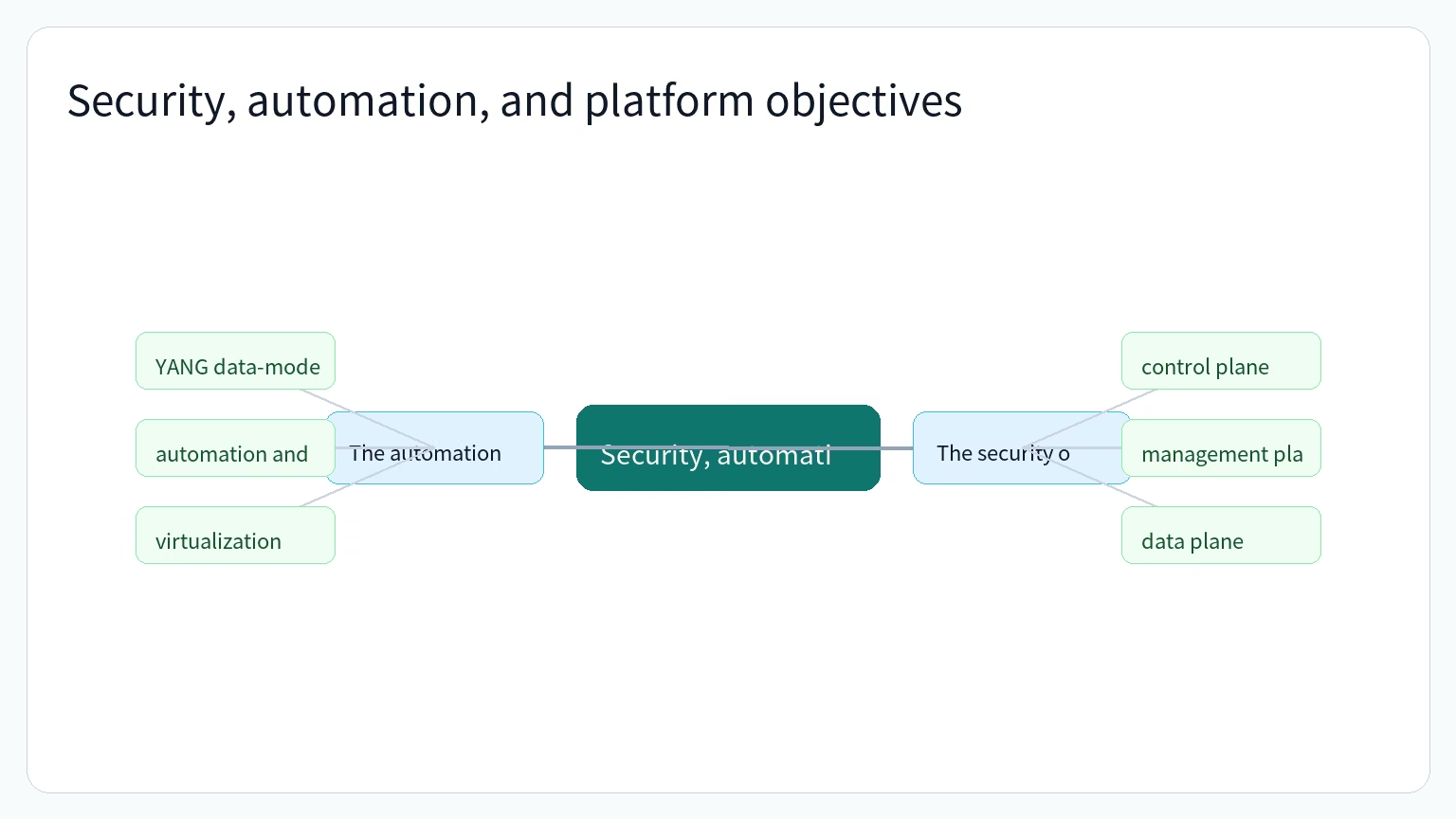
Security and operational technology areas are part of the same documented objective set. The page lists control-plane, management-plane, and data-plane security in Cisco devices. It also lists the YANG data-modeling language, automation and assurance tools and protocols, the role of Cisco Network Services Orchestrator in Service Provider environments, and virtualization technologies in those environments.
Taken together, the supplied material frames the course around configuration, verification, troubleshooting, optimization, and the listed technical objectives. The supplied source does not provide a separate claim that every objective receives the same amount of instructional time, so the objective names are best used as an organizational view of the documented training scope.
Choose between the listed training delivery options
The page lists two ways to get the training: a Cisco U Learning Path and instructor-led training. The descriptions distinguish a guided learning-path format from classroom-style learning and discussions delivered online or in person. Neither description states that one option is better than the other for a particular learner.
| Listed option | Documented description | Documented assessment or delivery detail |
|---|---|---|
| Cisco U Learning Path | A guided Learning Path designed for certification success | Pre- and post-assessments help learners skip what they know and focus on what they need to learn. |
| Instructor-led training | Classroom-style learning and discussions | Available online or in person and led by Cisco and Learning Partners. |
Cisco U Learning Path and assessments
Cisco describes the Cisco U option as a guided Learning Path designed for certification success. The page specifically says that pre- and post-assessments help learners skip material they know and focus on learning they need. That assessment description is the documented feature that accompanies the Learning Path; the supplied page does not describe a learner-specific recommendation rule beyond that statement.
A reader evaluating this route can therefore identify two stated elements: the path is guided, and it includes pre- and post-assessments intended to focus learning on needed material. The supplied text does not state how those assessments are scored, what content they contain, or whether they replace any of the named training activities.
Instructor-led training format
The instructor-led option is described as lively classroom-style learning and discussions. The same description says those sessions are available online or in person and are led by Cisco and its Learning Partners. This establishes the stated format and delivery locations without adding a comparison about outcomes, cost, scheduling, or suitability.
The supplied training page does not describe particular instructors, class sizes, session lengths, or an individualized selection criterion for this format. It does, however, identify the delivery distinction clearly: instructor-led training involves classroom-style learning and discussions, whereas the Cisco U option is presented as a guided Learning Path with the stated pre- and post-assessments.
Use the documented objectives to structure study activities
The objectives can be read as a set of documented study areas rather than as a claim about an exhaustive exam blueprint. One useful structure is to group them into routing and architecture, services and traffic, security, and operational technologies. This structure is a concise synthesis of the supplied objective list, not an additional technical requirement from the source.
Routing, transport, and service objectives
For architecture and routing, the page names Service Provider network architectures, concepts, and transport technologies. It also names Cisco IOS software architectures, main IOS types, and their differences. The routing objectives call for implementing OSPF, IS-IS, and BGP in Service Provider settings, implementing route maps and routing policy language, and describing IPv6 transition mechanisms used in Service Provider networks.
For service and traffic topics, the page lists high availability in Cisco IOS XR software, traffic engineering in modern Service Provider networks, and segment routing with segment-routing traffic-engineering concepts. It further lists VPN technologies, configuration and verification of MPLS L2VPN, configuration and verification of MPLS L3VPN, and implementation of IP multicast services.
QoS is separately represented in the documented objectives. The page calls for describing QoS architecture and QoS benefits for Service Provider networks, as well as implementing QoS in Service Provider environments. These items place QoS beside routing, MPLS, VPN, multicast, availability, and traffic-engineering topics in the stated training coverage.
Security, automation, and platform objectives
The security objectives are divided into three named planes: control plane, management plane, and data plane. For each, the page states an objective to implement security in Cisco devices. The wording identifies the planes but does not provide configuration examples, product-specific commands, or a priority order among the three areas.
The automation and platform portion names the YANG data-modeling language and implementation of automation and assurance tools and protocols.
Prerequisites and lab activities listed on the training page
The documented prerequisites are intermediate knowledge of Cisco IOS or IOS XE; familiarity with Cisco IOS or IOS XE and Cisco IOS XR Software configuration; knowledge of IPv4 and IPv6 TCP/IP networking; intermediate knowledge of IP routing protocols; understanding of MPLS technologies; and familiarity with VPN technologies. The page labels these items as prerequisites, but the supplied text does not state that they are admission requirements or describe a method for verifying them.
The lab outline names deployment of Cisco IOS XR and IOS XE, basic device configuration, OSPF routing, Integrated IS-IS routing, and basic BGP routing. It also names filtering BGP prefixes using RPL, implementing MPLS in the Service Provider core, Cisco MPLS Traffic Engineering, segment routing, Ethernet over MPLS, MPLS L3VPN, BGP security, and Remotely Triggered Black Hole filtering.
The named labs are documented hands-on activities on the training page. They can be used to review the activities the source explicitly lists, but the supplied page does not say that the outline is complete, does not provide lab instructions, and does not establish that completing each named lab guarantees any particular result.
A source-bounded way to review the training
The supplied material supports a focused review: identify the listed delivery format, note the stated role of Learning Path assessments, compare the stated online-or-in-person instructor-led description, and organize preparation around the named objectives, prerequisites, and labs. It does not support claims about pricing, registration, commercial-resource rankings, learner outcomes, or a complete exam blueprint.
For the documented scope, the central thread is consistent: the training names Service Provider IP network activities and a broad set of architecture, routing, services, QoS, security, automation, assurance, orchestration, and virtualization objectives. The delivery descriptions then provide the limited, explicit information available for distinguishing the guided Cisco U Learning Path from instructor-led classroom-style learning and discussions.