Table of contents
- Start with the feedback decision you need to make
- Map feedback requests to the customer journey
- Choose a channel that fits the moment
- Write requests that encourage honest, useful responses
- Follow up, act, and close the feedback loop
Collecting useful SaaS product feedback starts by deciding what you need to learn, then asking at a customer-journey moment and through a channel that fits that need.

The goal is not to ask every customer every question at once. Instead, connect each request to a specific product, experience, support, or relationship decision. That approach keeps the request focused and gives customers a clearer reason to spend time responding.
Start with the feedback decision you need to make
Customer feedback can help a SaaS team understand which features customers value, which functionality may be missing, where the product needs improvement, and how people experience the product. It can also help a team assess satisfaction, identify customers who may be dissatisfied, surface ideas for future features or services, and show customers that their opinions are valued.
Before writing a request, state the information you need. A team that needs to understand first impressions should ask about the signup or onboarding experience. A team evaluating a feature should focus on that feature and the task it supports. A team reviewing customer support should ask about the support interaction rather than asking for a broad judgment about the entire product.
This framing also helps determine how much detail to request. Feedback can include quantitative responses, such as ratings or multiple-choice selections, and qualitative responses, such as open-ended comments. Using both can provide a broader view of the customer's perspective when the decision needs both a measure and an explanation.
Match the request to the information you need
Questions to ask customers about your product should reflect the information the team intends to use. For satisfaction, the request can ask customers to rate their overall experience or a specific part of the product. For usability, it can ask whether a task was easy to complete and invite the customer to describe difficulties. For product development, it can focus on valued features, unused features, desired changes, or missing functionality.
Support feedback should stay focused on the support experience, while a pre-renewal request can ask what customers like, what needs improvement, and whether they expect to renew. A churn request can seek the reason a customer cancelled or chose not to renew. The question set does not need to cover every possible topic; it should include only the questions needed to obtain valuable information for the defined objective.
Keep the wording short without removing the meaning needed for a useful answer. Explain terms, product names, or rating scales that may be unfamiliar to the customer. When a request takes more than a quick interaction, tell customers how much time it requires so they can decide whether to participate.
Map feedback requests to the customer journey
Different customer-journey moments can reveal different parts of the experience. At free-trial signup or onboarding, a request can gather initial impressions of the signup process, ease of use, issues encountered, and early suggestions. After a customer completes an important task for the first time or uses a new feature, an in-app request can focus on that milestone or feature while the experience is recent.
During regular use, periodic requests can help a team understand whether the product continues to meet customer needs and whether customers see missing or unnecessary features. After a support or customer-success interaction, feedback can help assess the quality of the support experience. After a release or product update, teams can ask customers how they find the change and whether the new functionality has usability issues.
Before a subscription renewal, feedback can provide information about what customers like, what they want improved, and their likelihood of renewing. When a customer cancels or does not renew, asking why they left can identify dissatisfaction or a specific cause of churn. These moments create different opportunities for learning, so the request should match the event rather than relying on one universal timing rule.
Give users time to understand the product
Broad product feedback is less useful when customers have not had time to become familiar with the product. A first login is not necessarily the right moment for a broad survey because the customer may not yet have used the product enough to assess it.
Teams can wait until an appropriate amount of time has passed, a customer has completed relevant actions, or important features have been used. The appropriate setup depends on the product's complexity, but the underlying purpose is consistent: ask for broad feedback after customers have enough experience to provide an informed response.
Frequency also depends on the type of request and the effort required from the customer. A short support rating can follow a support conversation, while an extensive product survey should be spaced out so customers are not overwhelmed. Respecting customer time is part of collecting feedback without turning the request process into another source of friction.
Choose a channel that fits the moment
Email can reach customers who are not actively using the product and can be used to target customers at different journey stages or in specific segments. It is useful when the feedback request is tied to a trial ending, a renewal, a longer-term experience, or another event that does not require the customer to be inside the product at that moment.
In-app prompts, forms, and feedback boards can collect feedback after a key action, on a particular screen, or after a customer uses a new feature. These channels can keep the request close to the relevant experience. In-product forms should not be intrusive to the user experience, and a prompt should not prevent the customer from continuing the next action.
Customer support is another practical collection point because support teams interact directly with customers and hear both pain points and praise. Teams can make it easier for support staff to capture feedback on a customer's behalf or direct customers to a survey or feedback board. Feedback from unhappy customers matters as well as feedback from happy customers because it may identify issues that need attention.
User interviews and usability tests are appropriate when a team needs more detailed insight into customer needs, pain points, behavior, or experience with a product or new feature. An always-available website form, in-product feedback option, or feedback board gives customers a way to share input outside scheduled outreach.
Keep in-product feedback discoverable but unobtrusive
A feedback option should be visible enough for customers to find when they want to share something. At the same time, the option should avoid disrupting normal product use. A persistent placement can remain available without requiring a customer to act immediately, and an embedded option at the end of a relevant flow can request feedback without blocking the next action.
Placement should also reflect the product context. A menu can keep an option out of the way but may be difficult to find if it is labeled poorly. A feedback item in a familiar, persistent location can be easier to discover, while a specific flow can be a relevant place to request feedback about that flow.
Write requests that encourage honest, useful responses
A feedback request asks customers to give time they are not required to give, so appreciation and a clear explanation of how the feedback can help improve the product or experience are useful parts of the message. The request can sound connected to a real customer relationship by using the customer's name or company where practical, sending from a real person's name, and responding individually to submitted feedback.
Keep questions as short and simple as possible while preserving enough context for customers to understand what is being asked. Avoid jargon that customers may not know, and explain any necessary terminology, names, stars, numbers, or scales. State the expected completion time when relevant, and avoid adding questions that are not needed for the decision.
Do not use wording that directs customers toward a positive answer. A neutral rating request and an invitation to explain the rating can produce more honest input than a self-congratulatory question. Customers should also have an additional-comments field or another open space to share relevant information that the predetermined response options did not capture.
Use a balanced mix of response formats
Rating scales, multiple-choice questions, and other structured formats can provide quantitative feedback. Open-ended prompts can reveal difficulties, desired changes, reasons behind a rating, and information that a fixed list of options misses.
The right mix depends on the feedback objective. A short post-support request may need a focused rating and an optional comment, while a deeper product-learning effort may need more room for explanation. What are some good survey questions for a product is therefore less important than whether the selected questions match the customer moment and the information the team needs.
Avoid sending every possible question in one form. A succinct request that focuses on the most important questions can reduce unnecessary effort for the customer while leaving room for useful comments.
Follow up, act, and close the feedback loop
Collecting feedback is only the beginning of the process. Teams can analyze submitted feedback for trends and common issues, draw insights from it, and use those insights to guide product improvements. Feedback that identifies a customer concern can also be routed to the customer-success or support team for attention.
Follow-up should be proportionate to the effort the customer made. A short board submission or survey response may receive a quick thank-you, while a longer and more involved response can receive a personal note. In both cases, thanking customers acknowledges the time they spent sharing their perspective.
Close the feedback loop by telling customers their input was heard and by communicating changes or product updates made in response to feedback. This does not require promising that every request will be implemented. It means showing customers that their feedback entered a process of review and can inform product decisions.
Treat negative feedback as an input for improvement
Negative feedback can reveal customer concerns, product issues, or experience problems that deserve attention. When a customer leaves negative feedback, a response can thank them for sharing it, ask for clarification when needed, acknowledge the concern, and offer to address it when possible.
Do not filter collection efforts toward only positive feedback. Hearing from unhappy customers can surface real issues that a team should address, and support or customer-success follow-up can help handle an individual concern. Combining respectful collection, focused analysis, action, and communication gives feedback a role in ongoing product and customer-experience improvement.
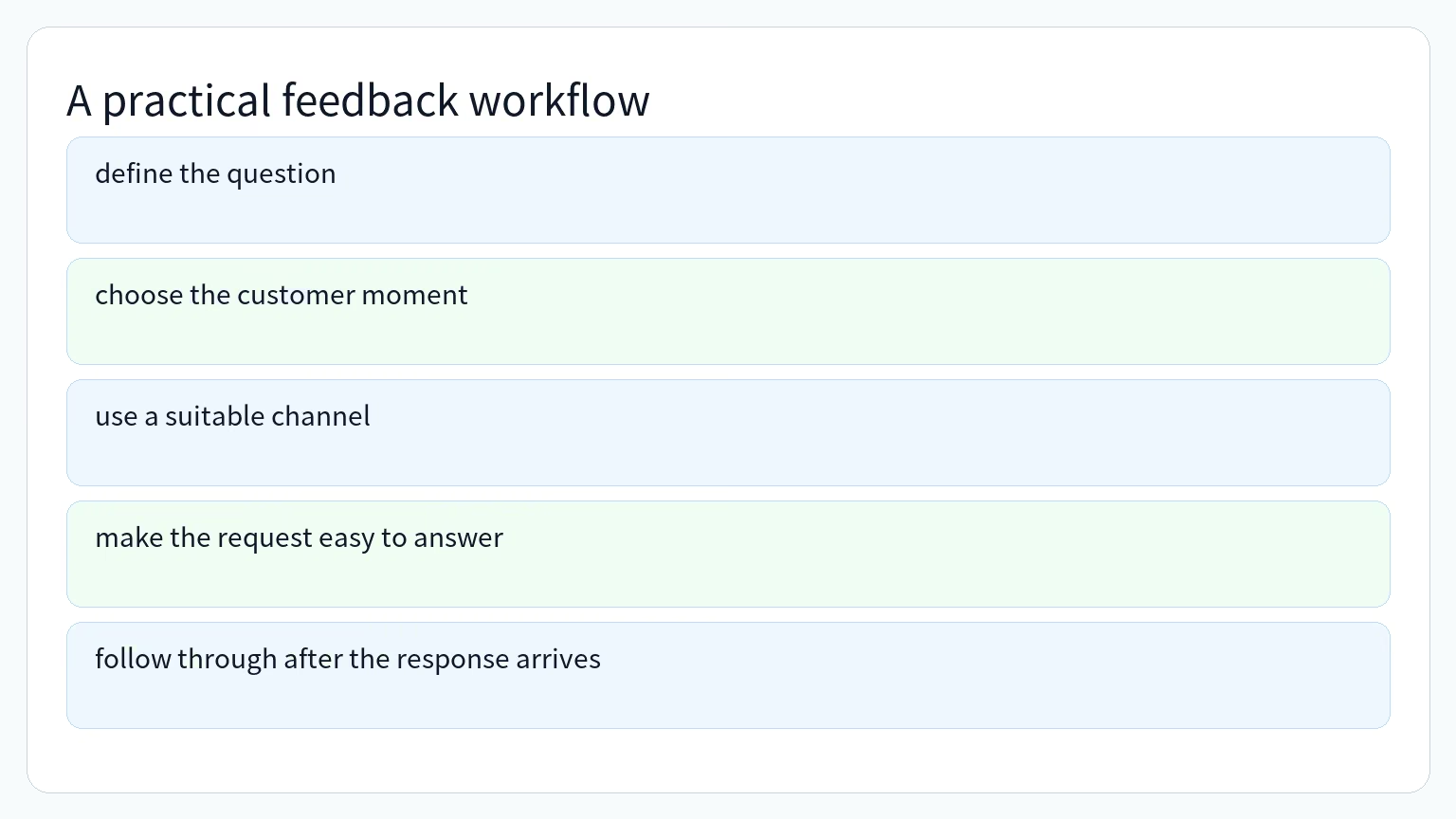
A practical feedback workflow is therefore decision-led rather than channel-led: define the question, choose the customer moment, use a suitable channel, make the request easy to answer, and follow through after the response arrives.