Table of contents
- What the documented PMP test format includes
- Standard selection and response formats
- Matching, graphic, and point-and-click interactions
- Case, scenario, and drag-and-drop formats
- How to practice for the described interactions
- Bottom line
The PMP test format includes familiar response types such as multiple-choice, multiple-response, matching, hotspot or graphic-based questions, and fill-in-the-blank interactions.
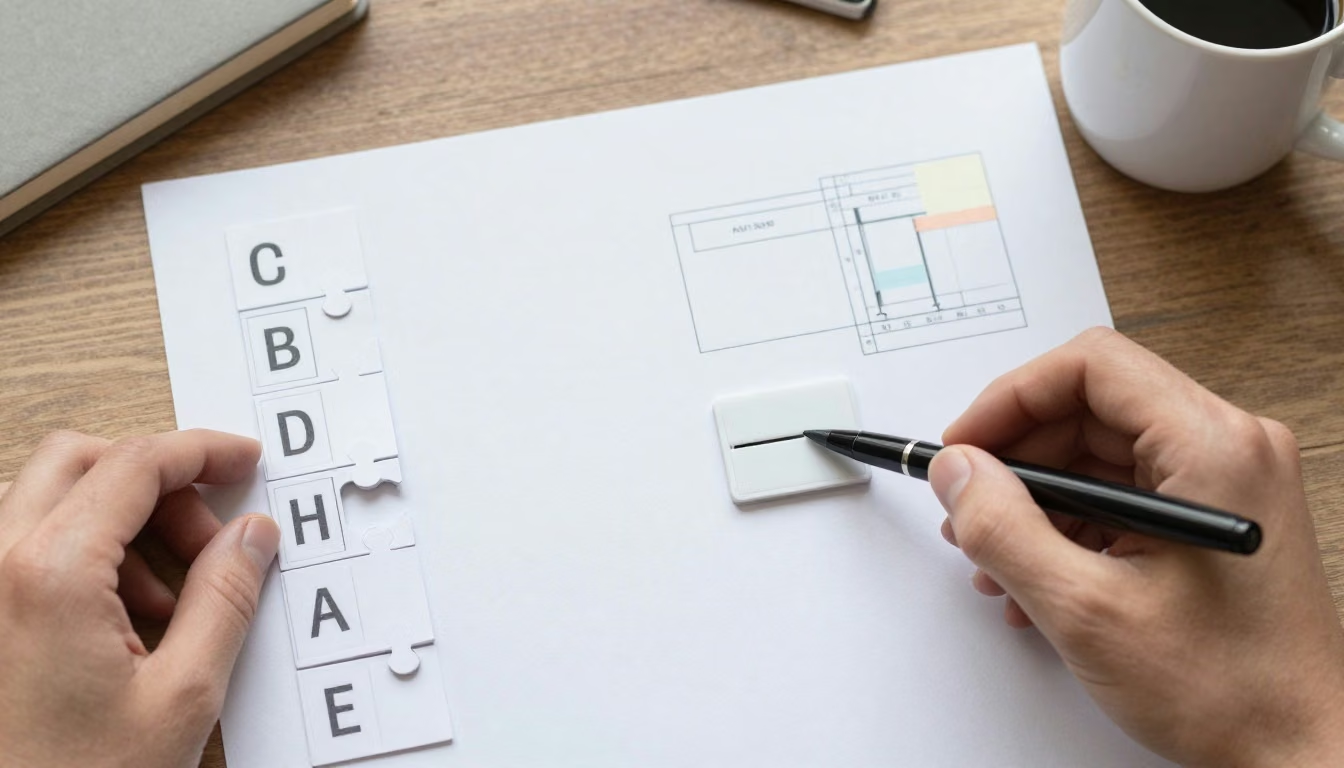
The format lists should not be treated as one completely undisputed catalog. PassDump reports eight question types from the July 2026 Exam Content Outline, while PassDump describes five carried-over formats and a broader set of interactive variants. The most useful way to read the descriptions is to separate the reported official-looking type labels from the practical interaction mechanics described by the preparation page.
What the documented PMP test format includes
PassDump reports these eight types in the July 2026 Exam Content Outline: Case or Scenario, Graphic-Based Questions, Multiple-Choice Single Response, Multiple-Response, Enhanced Matching, Matching, Point and Click, and Pull-down List. PassDump identifies Case or Scenario and Graphic-Based Questions as the two types labeled NEW by PMI.
PassDump separately describes multiple choice, multiple response, matching, hotspot, and fill-in-the-blank as five core formats carried over from the earlier exam description. It also describes case or scenario-based question sets, drag-and-drop ordering, drag-and-drop matching, drag-and-drop categorization, pull-down lists, and enhanced fill-in-the-blank with data interpretation.
These descriptions overlap, but they are not organized in exactly the same way. For example, PassDump uses the labels Graphic-Based Questions and Point and Click, whereas PassDump uses hotspot for an interaction in which the candidate clicks an area of an image, diagram, or chart. PassDump also lists Enhanced Matching as a documented label, while PassDump explains traditional matching and drag-and-drop matching as separate mechanics. The difference matters because a type label and an interaction description do not necessarily describe the same level of classification.
Standard selection and response formats
Multiple choice versus multiple response
In the PassDump description, a multiple-choice single-response question presents answer options and has exactly one correct answer. The page gives a standard arrangement with four options labeled A through D. The challenge described for this format is selecting the best answer after analyzing the scenario, rather than learning a special interface mechanic.
A multiple-response question requires selecting all correct answers. PassDump gives examples in which the question specifies a number, such as “Select TWO” or “Select THREE.” The description states that credit is received only when the exact correct combination is selected and that partial credit is not awarded.
The practical difference is therefore the size of the answer set that must be completed. With single response, the task is to choose one option. With multiple response, choosing an option that is partly correct does not complete the task if the required combination is not exact. Practice should reflect that difference: one activity should focus on selecting the strongest single answer, while another should require identifying the complete combination requested by the question.
Fill-in and pull-down interactions
PassDump describes basic fill-in-the-blank questions as requiring the candidate to type an answer. The answer may be a specific term, number, or short phrase. This format differs from selection questions because the candidate must produce the response rather than choose it from labeled options.
Pull-down questions use predefined options instead of free-text entry. The described interaction presents a statement or scenario with one or more blanks, and the candidate selects an option from a dropdown menu for each blank. PassDump describes this as similar to fill-in-the-blank while removing the ambiguity associated with typing an answer.
PassDump also describes enhanced fill-in-the-blank questions with multiple blanks and reference data such as tables or charts. The candidate uses the reference material to determine the required responses. This means that basic fill-in and enhanced fill-in should be practiced differently: the first emphasizes entering a precise term, number, or short phrase, while the second combines typed responses with interpretation of the displayed material.
Matching, graphic, and point-and-click interactions
Matching and enhanced matching
A traditional matching question presents two lists whose items must be paired. PassDump describes examples that match project-management techniques with their descriptions and tools or leadership styles with situations. The interaction requires the candidate to connect each item on one list to the appropriate item on the other list.
PassDump includes Matching and Enhanced Matching as separate entries in its reported eight-type list. The supplied descriptions do not establish additional mechanics for Enhanced Matching, so that label should be retained without assigning it a more specific behavior. The supported distinction is that Matching is explained through paired lists, while Enhanced Matching is a separately reported type name whose detailed mechanics are not defined in the available description.
PassDump also describes drag-and-drop matching. In that interaction, items are dragged from a source list to their correct targets. It resembles traditional matching in its logical task, but the response is performed through an interactive drag operation rather than simply pairing items in a static list.
Graphic-based and point-and-click questions
PassDump describes hotspot questions as showing an image, diagram, or chart and requiring the candidate to click the correct area. Its examples include identifying a phase in a project lifecycle diagram or pointing to a location on a network diagram.
PassDump lists Graphic-Based Questions and Point and Click separately. The combined descriptions support a visual family of interactions, but they do not establish that every graphic-based question uses the same response mechanic. A graphic-based question may involve visual material, while Point and Click identifies a particular way of responding to that material.
Practice for these interactions should therefore begin with reading the visual artifact and then connecting it to the question. PassDump specifically describes charts, diagrams, project data, network diagrams, earned-value tables, and stakeholder grids as kinds of material associated with the formats it discusses. The supported preparation task is interpretation of the displayed material, not memorization of a universal visual-question procedure.
Case, scenario, and drag-and-drop formats
Case and scenario question sets
PassDump describes a case study as a detailed project scenario that may include charts, data tables, organizational charts, or project schedules. Several related questions are anchored to the same project context. The scenario information carries across the questions, so the questions are designed to be read together rather than treated as unrelated standalone items.
PassDump reports that the exam opens with a dedicated case-study section. PassDump describes case studies as appearing before independent questions, with standalone questions in a later part. These descriptions support the existence of a shared-context section followed by independent questions, while the available material does not resolve every difference in how the sections are labeled.
The shared context changes the reading task. A candidate must track the conditions, data, and relationships established in the scenario before answering the associated questions. PassDump describes case-study questions as testing integrated thinking because the candidate may need to synthesize information from multiple parts of the project context. It also states that the setup paragraph and tables remain visible across the questions in a set, so the candidate does not need to memorize them.
Ordering, matching, and categorization
Drag-and-drop ordering requires arranging items in the correct sequence. PassDump describes this as testing process sequences and logical dependencies rather than only recognition of definitions. Practice for ordering interactions should therefore focus on understanding which activity precedes another and why the sequence matters.
Drag-and-drop matching connects source items to their correct targets. The mechanic is similar to matching, but the candidate moves the items through a drag operation. This format can be practiced by pairing artifacts, activities, or other items with the targets that the question presents.
Drag-and-drop categorization requires sorting items into appropriate buckets. PassDump describes examples in which cost items are classified into Prevention Costs, Appraisal Costs, or Failure Costs. The supported preparation activity is classification practice: identify the category represented by each item and place it in the corresponding bucket.
How to practice for the described interactions
Practice the unfamiliar interactions before using them in a timed setting. PassDump recommends becoming familiar with drag-and-drop, pull-down, and case-study questions so that the interface does not consume attention during the exam.
Match each practice activity to the interaction mechanic. For ordering questions, review process flows and logical dependencies, then arrange activities in sequence. For categorization questions, practice sorting items into the correct framework or bucket. For matching questions, connect each source item to its target. For visual questions, practice interpreting charts, tables, diagrams, and other project artifacts.
Case-study practice should involve more than answering isolated multiple-choice questions. PassDump recommends practicing integrated analysis across multiple project-management areas, including scope, schedule, cost, risk, and stakeholders. Its description of shared scenarios supports working from the common context and synthesizing the information that applies across related questions.
Enhanced fill-in practice should combine data interpretation with exact responses. PassDump associates this format with multiple blanks and reference data such as charts or tables. A useful practice activity is therefore to read the displayed data, determine what each blank asks for, and enter the required term, number, or short phrase.
The central preparation principle is format matching. Multiple-choice practice should include selecting one best answer; multiple-response practice should require the exact requested combination; ordering practice should test sequence; categorization practice should test classification; and case practice should require analysis across one continuing scenario. The sources describe these as different interaction demands, so treating every question as an ordinary four-option item would not rehearse all of the mechanics described for the current format.
Bottom line
The documented PMP test format combines familiar response types with interactive formats that require sequencing, matching, categorization, visual interpretation, typed responses, and analysis across a shared case context. PassDump reports eight named types and marks Case or Scenario and Graphic-Based Questions as NEW by PMI. PassDump provides a broader practical description that includes the five carried-over formats plus case, drag-and-drop, pull-down, and enhanced fill-in interactions.
Because the two descriptions classify the formats differently, preserve their attribution instead of forcing them into one definitive list. Prepare by practicing the mechanics that each description identifies, especially shared-scenario analysis, visual interpretation, exact multiple-response selection, ordering, matching, categorization, pull-down selection, and enhanced fill-in responses.