Table of contents
- Why exam-question dumps are not the preparation route covered here
- Start with the free study materials recommended in the discussion
- Use practice tests to check what you understand
- A simple preparation sequence without dumps
The preparation route covered here is to study free material, take a practice test, review the results, and then take the exam without using exam-question dumps. A Juniper community discussion specifically recommends this route for candidates looking for JNCIA material instead of questions and answers from an exam bank.
This approach keeps the work focused on learning the material and checking understanding before the live exam. It does not involve obtaining, sharing, reviewing, or memorizing live exam items. The goal is to prepare through study and practice rather than through a collection of purported exam questions.

Why exam-question dumps are not the preparation route covered here
An exam-question dump is not a substitute for learning the JNCIA-Junos material. In the community discussion, using a method to learn all questions and answers before taking an exam is described as cheating. The same discussion says that Juniper exam terms and conditions forbid cheating.
That distinction matters because a candidate can approach preparation in two very different ways. One approach is to seek answers that are presented as exam content. The other is to work through study material, use practice testing as preparation, and sit the exam after building understanding. This article covers the second approach.
The discussion also says that candidates should use only Juniper-recommended study resources during exam preparation. It warns that third-party materials or sites can contain live exam items. Rather than trying to judge whether a question bank is safe to use, keep preparation centered on learning resources and practice activities that do not require access to live exam content.
The practical boundary is straightforward. Do not acquire dumps. Do not ask others to send exam questions or answers. Do not repost, trade, or review purported live exam items. Do not treat a memory-based answer list as a study plan. Those activities do not help build a preparation routine based on studying the material and testing what you understand.
A lawful preparation route can still be structured and deliberate. It can include study sessions, practice attempts, answer review, and targeted return visits to material that needs more attention. The important difference is that the work is based on learning and preparation, not on trying to reproduce the live exam.
Start with the free study materials recommended in the discussion
The community discussion directs candidates to obtain free study material through the Fast Track route, learn the material, take a practice exam, and then take the exam properly. That gives the preparation sequence its starting point: begin by studying instead of beginning with a question bank.
Start by treating the study material as the main body of work. Read it with the purpose of understanding the material, not merely spotting phrases that might appear in a question. Pause when a topic is unclear. Return to the relevant material when an explanation does not yet make sense. The study stage should come before the practice-test stage because the recommended sequence is to learn the material and then take the practice exam.
A useful way to keep this stage focused is to separate learning from checking. During learning, concentrate on the concepts and explanations in the study material. Avoid turning every paragraph into a prediction about the live exam. When preparation becomes a search for likely question wording, the focus shifts away from the material itself and toward the kind of exam-question content this route excludes.
Use notes only as a way to organize what you are learning from the material. For example, record a topic that needs another review, a term that needs clarification, or a section to revisit after a practice attempt. Do not use notes to collect or reconstruct live exam questions. The purpose of notes in this route is to guide further study.
Study can also be divided into manageable passes. In an early pass, work through the material to establish familiarity. In a later pass, return to areas that were difficult or incomplete. This is not a claim that every candidate should use the same schedule. It is a way to apply the discussion's basic direction to learn the material before taking the practice exam.
The key decision at this point is simple: choose learning material over dumps. The community discussion presents free study material as the alternative to seeking JNCIA dumps, and it frames passing the exam properly as the result of learning, practice, time, and effort.
Use practice tests to check what you understand
After studying, take a practice test. The JNCIA-Junos certification practice test is described as a tool designed to help candidates prepare for the live exam. Its role is preparation: it gives a candidate a chance to answer questions, see the result, and use the review information to decide what needs more study.
The practice test provides the correct response or responses for each question after completion. It also provides an explanation for why each response is correct. That makes the review stage as important as the attempt itself. A score alone tells you only that some responses were correct and some were not. The correct responses and explanations provide material for understanding what the practice test was assessing.
When reviewing, do not simply replace an incorrect answer with the correct one and move on. Read the explanation. Identify the point in the explanation that changed your understanding. Then return to the study material for that point. This turns a missed question into a study task rather than a fact to memorize without context.
The practice test has unlimited attempts, but its questions do not change. Unlimited attempts can support repeated review, yet the unchanged question set means repeated attempts should not become a memorization exercise. Use another attempt to check whether the explanation and follow-up study improved your understanding. If the answer is correct only because the question is familiar, return to the study material and review the underlying topic.
The displayed practice-test passing score is 70%. The practice-test page states that this score is not necessarily the passing score of the live exam. A practice result should therefore be treated as a result from the practice test, not as a statement of the live-exam threshold.
This distinction is especially useful when interpreting a score. A result at or above the displayed practice threshold does not establish the live-exam passing score. A result below that threshold does not establish what would happen on the live exam either. Use the result as a preparation signal: review the responses and explanations, identify what needs more study, and then revisit the material.
What practice questions can help you identify
Practice questions can help identify areas that need more attention before an attempt at the real exam. A JNCIA quiz page describes practice tests as a way to show knowledge before the real exam and cover missing points again before attempting it. The useful part of that idea is not the existence of more questions; it is the chance to discover a point that needs another study pass.
A missed practice question can indicate that an explanation was not yet understood, that a topic has not been reviewed recently, or that the connection between two parts of the material is unclear. Those are study signals. Use them to decide where to return, what explanation to reread, and what material to learn more carefully.
A correct practice response can also deserve review. Check whether you can explain why the response is correct using the study material. If you cannot, treat the correct response as a prompt for more learning rather than as proof that the topic is complete. The practice-test explanations are available after completion, so they can be used to review both correct and incorrect responses.
Keep the review focused on preparation gaps. Do not turn practice questions into a reconstructed exam bank. Do not seek additional live items to fill perceived gaps. The preparation route is to return to the study material, learn the point that was missing, and use a later practice attempt to check whether that work improved understanding.
A simple preparation sequence without dumps
Use this sequence to organize the preparation route described in the community discussion and practice-test information.
-
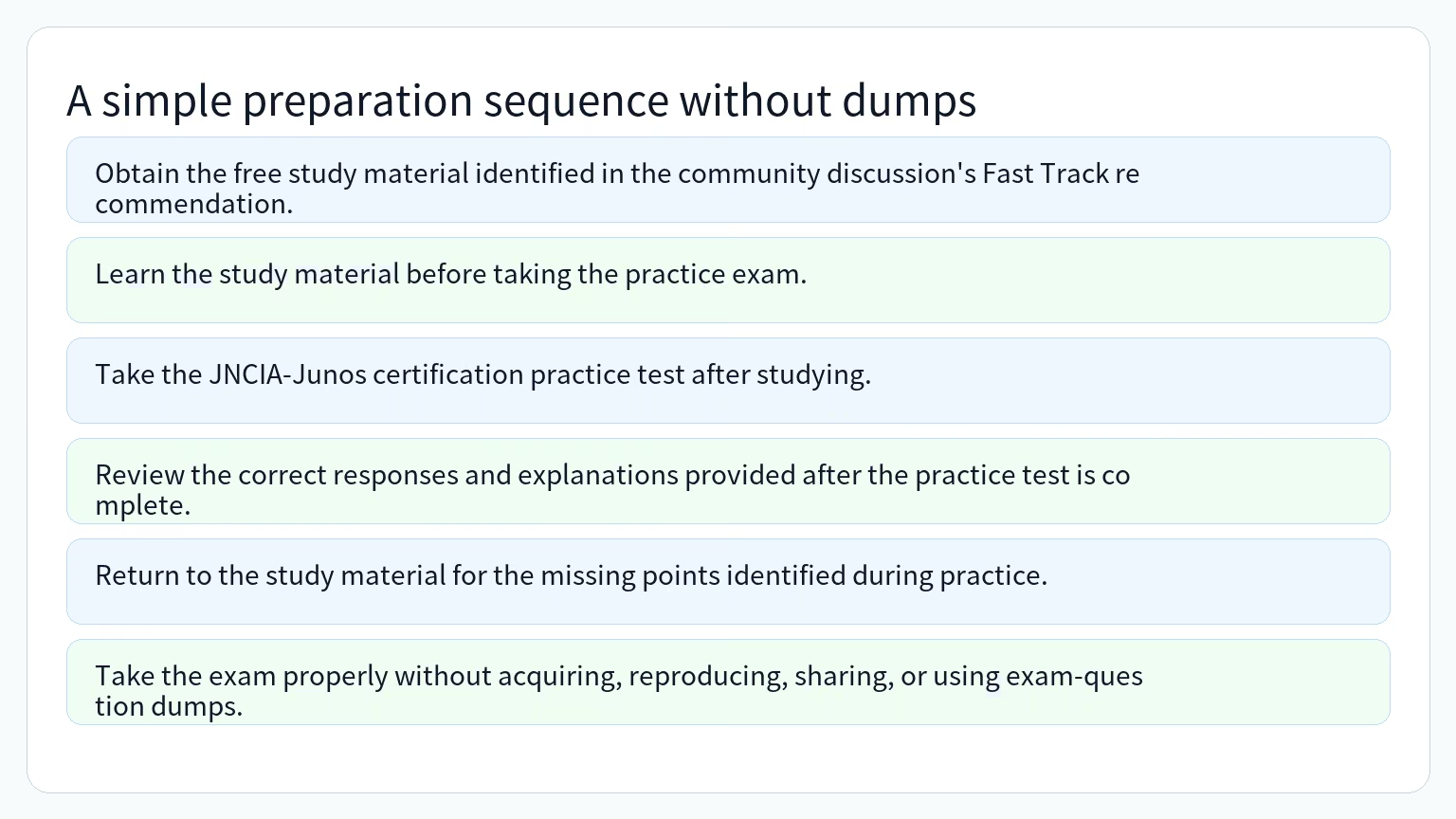
Obtain the free study material identified in the community discussion's Fast Track recommendation.
-
Learn the study material before taking the practice exam. Focus on understanding the material rather than collecting possible exam questions.
-
Take the JNCIA-Junos certification practice test after studying. Treat the attempt as preparation for the live exam.
-
Review the correct responses and explanations provided after the practice test is complete. Record the topics that need another study pass.
-
Return to the study material for the missing points identified during practice. Work through the relevant explanations again before relying on another score.
-
Use another practice attempt to check understanding after further study. The practice test permits unlimited attempts, while its question set does not change.
-
Interpret the displayed 70% as the practice-test score shown on that page, not as a declaration of the live-exam passing score.
-
Take the exam properly without acquiring, reproducing, sharing, or using exam-question dumps.
This sequence has a clear order: study first, practice second, review third, and return to study when practice reveals missing points.
The route does not promise an exam outcome. It provides a preparation process supported by the available study-material recommendation and practice-test information. The quality of the process comes from using practice results to guide more study, rather than from trying to memorize answers that are claimed to come from a live exam.
For JNCIA-Junos candidates who arrive looking for JNCIA dumps or JNCIA-Junos exam questions, the practical answer is to redirect that effort. Start with the free study-material route described in the discussion. Learn the material. Take the practice exam. Review every explanation that helps reveal a missing point. Return to the material. Then approach the exam without dumps.